

AI SEO services built on evidence, not guesswork
I test the questions your buyers ask in ChatGPT, Perplexity, Google's AI Overviews and Copilot. I record where your business is mentioned, what is said about it and which sources are cited, then tell you what is worth fixing first.
- Ongoing AI SEO from €690 a month
- Multi-platform research
- Prioritised recommendations
Do you need GEO, or better SEO?
Often, the honest answer is better SEO first.
Google says its AI Overviews and AI Mode have no extra technical requirements: a page needs to be indexed and eligible to appear with a snippet. If your key pages aren't indexed, important content is hard for search engines to read, or your pages say little that other sites don't, an AI-specific service won't make up for it.
AI assistants such as ChatGPT search and Copilot also look things up on the web when they answer. They may cite your website, but they also draw on other sites that mention you, such as reviews, directories, articles and comparison pages. Your own site is one source among several.
37.1%
So AI SEO builds on good SEO rather than replacing it. What is worth researching separately is how AI answers describe your business: whether you are mentioned, whether the details are accurate, which sources are cited, and where competitors appear instead of you. That is what my audit looks at.
What I work on
Each piece of work comes from something the first month's measurement found. I don't sell a fixed list of AI tactics.
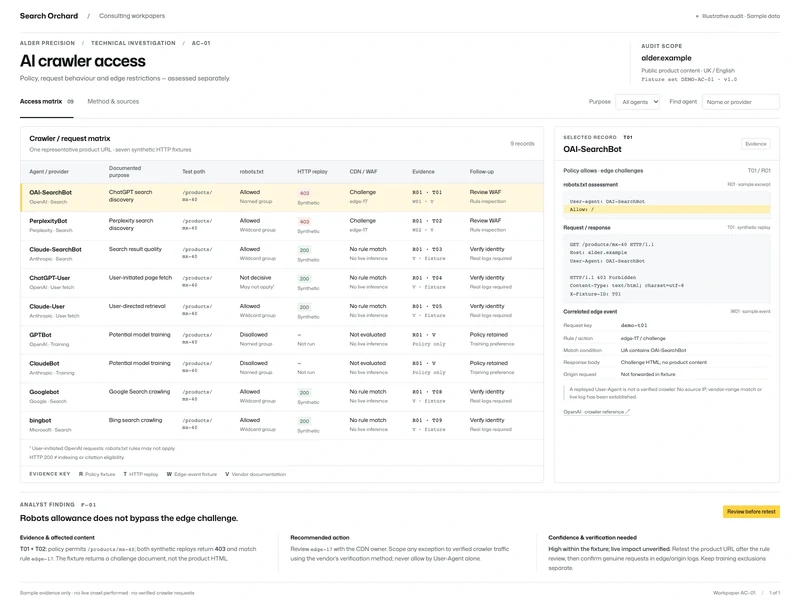
AI crawler access
I check whether your robots.txt, firewall or CDN settings stop the crawlers used by ChatGPT search, Perplexity, Claude and Bing from reaching your pages. Blocking crawlers that collect training data is a separate decision, and I'll explain the difference so you can make it.
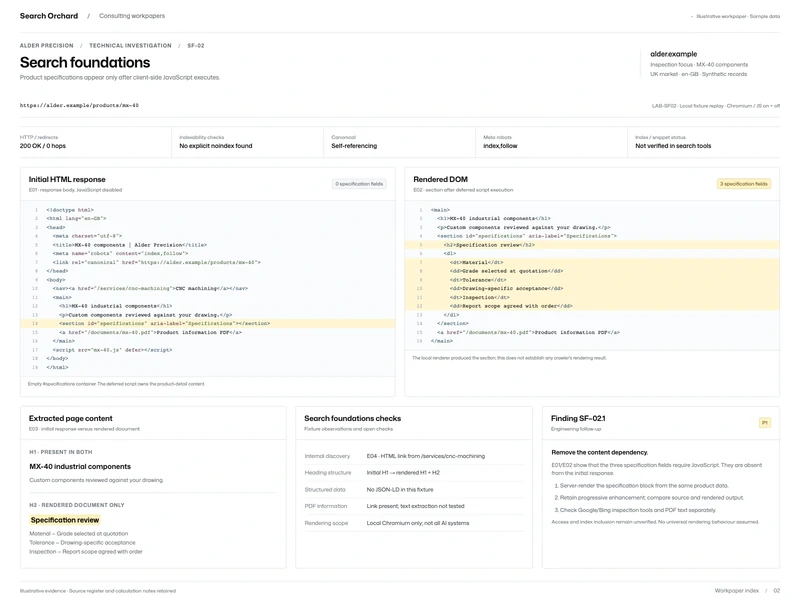
Search foundations
Indexing, snippet eligibility, JavaScript rendering, and content hidden in tabs, images or PDFs. If Google and Bing struggle to read a page, AI answers that draw on their results are less likely to use it.
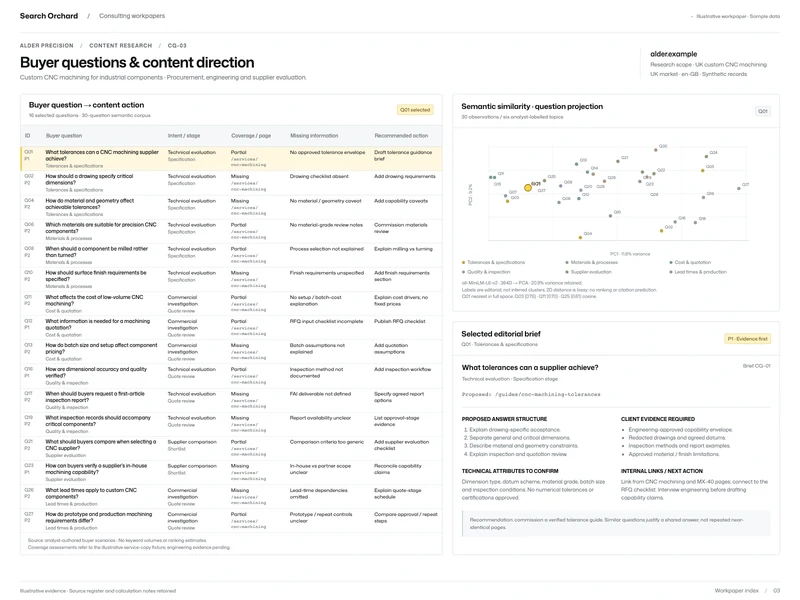
Pages that answer buyer questions
Clear answers to the questions buyers ask, with specific facts, specifications, prices and first-hand detail where you have them. This follows Google's and Microsoft's published guidance, not formatting tricks.
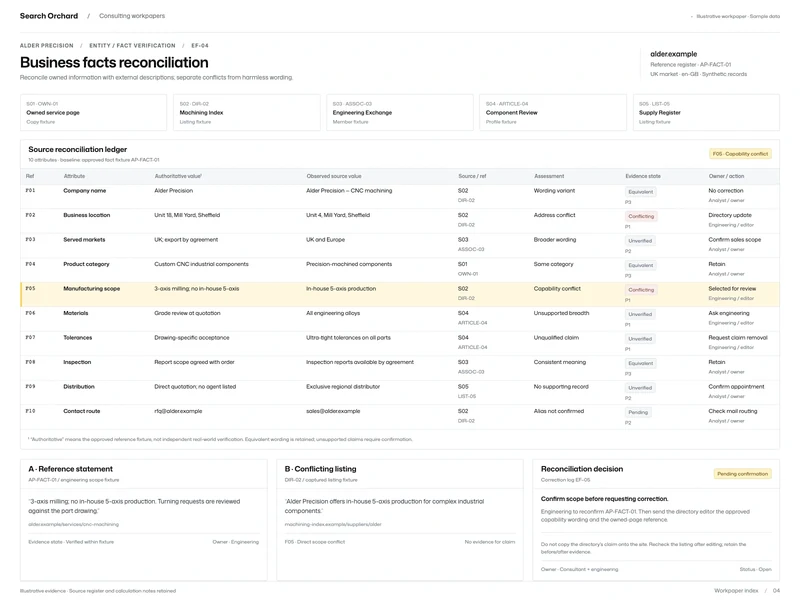
Accurate business facts
When AI answers get your services, prices, locations or company details wrong, I trace the likely source of the error and list what can be corrected, on your site and elsewhere.
Mentions on other sites
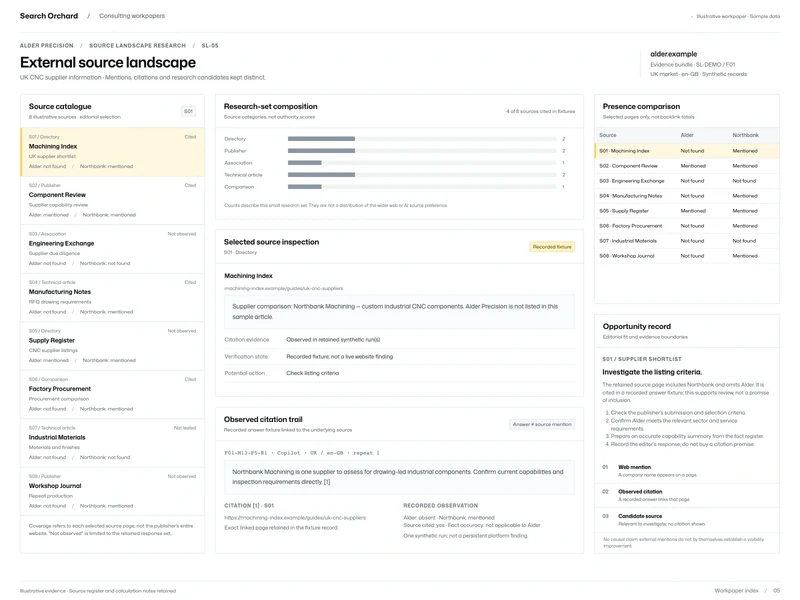
Reviews, directories, industry lists and articles that AI answers cite in your category. I identify which ones matter and which you can realistically appear in. Studies show a link between mentions across the web and AI visibility, but not that one causes the other.
Measurement
Search Console, AI referral traffic in GA4 and Bing Webmaster Tools' AI performance data, alongside a repeatable set of test questions, explained below.
Need your website itself checked first? See the SEO audit. Selling in more than one country? See International SEO. For a business that serves customers in one area, start with local SEO.
How I measure AI visibility
Research note: In a study of 2,961 AI responses, SparkToro and Gumshoe found that identical brand recommendation lists occurred in fewer than 1% of comparisons. Read the research
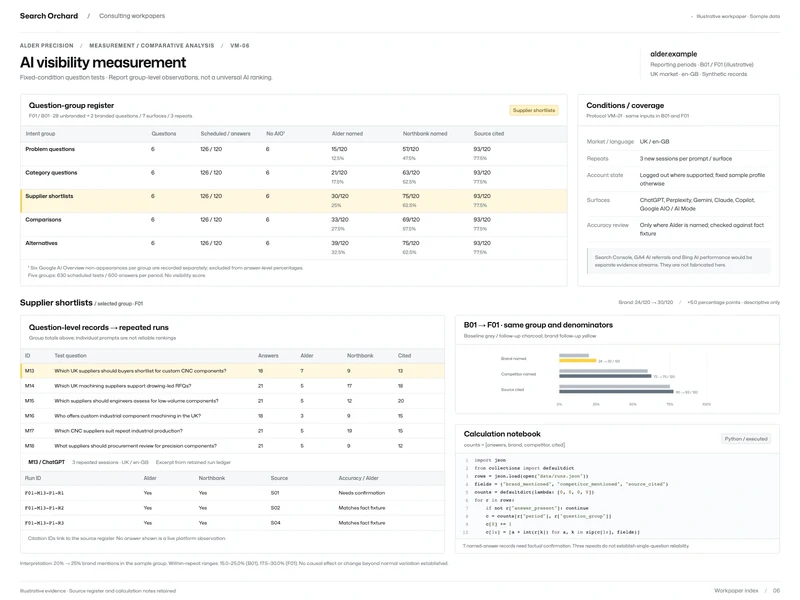
Alder Precision / Measurement / VM-06
AI visibility measurement
| ID | Question | Intent |
|---|---|---|
| Q03 | Why do low-volume CNC parts fail incoming inspection? | Problem |
| Q09 | What is the difference between 3-axis and 5-axis CNC machining? | Category |
| Q14 | Which UK suppliers make custom CNC components for low-volume runs? | Shortlist |
| Q22 | How do UK precision machining suppliers compare on lead times? | Comparison |
| Q27 | Alternatives to offshore CNC suppliers for UK manufacturers | Alternative |
| B02 | Does Alder Precision offer 5-axis machining? | Branded |
- Problems 6
- Categories 7
- Shortlists 6
- Comparisons 6
- Alternatives 5
Where the questions came from
Alder 5/20 · Northbank 14/20 · 1 non-triggered excluded. Three runs are observations, not a ranking.
“…for short runs, Northbank Machining is often recommended. Alder Precision also offers in-house 5-axis work…”
- Alder
- Mentioned · not cited
- Northbank
- Mentioned · cited
- Sources
- machining-index.example, northbank.example
- Accuracy
- Incorrect 5-axis is via a partner
Mention: named in the answer. Citation: linked as a source.
Gap machining-index.example drives 41 of 120 answers and lists Northbank, not Alder. None of its answers name Alder alone.
Alder named24 → 30
Northbank named75 → 72
Own site cited6 → 11
Bands: range across 3 repeats. 20% → 25% sits inside the overlap, so it is reported as descriptive, not proven.
rate = named ÷ answers; non-triggered AI Overviews excludedWorkpaper index / 06
Set up
01 Agree the questions
Around 30 buyer questions, selected through keyword research, sales conversations and competitor analysis. They cover product research, supplier selection and purchasing decisions, alongside a smaller set of branded questions to assess how accurately AI systems describe your business.
02 Group them by intent
Questions are grouped by intent: problems, product categories, supplier shortlists, comparisons and alternatives. This reveals where your business appears in the buying process, which competitors are recommended and where your brand is absent.
Measure
03 Test under consistent conditions
Each question is tested three times across the agreed AI platforms, including ChatGPT, Perplexity, Gemini, Claude, Copilot and Google where applicable. Market, language, date and session conditions are recorded for comparison. Google AI Overviews and AI Mode are measured separately; searches without an AI Overview are recorded as non-triggered, not counted as missed brand mentions.
04 Record what each answer says
Every response is assessed for brand mentions, competitor presence, factual accuracy and cited sources. Incorrect company details, outdated product information and misleading claims are recorded alongside the original answers, creating an auditable evidence base.
Improve
05 Find the gaps
I examine questions where competitors appear but your business does not, identify frequently cited third-party sources and investigate technical or content-related barriers. The findings distinguish missing visibility from inaccurate information and opportunities to improve your existing content or external presence.
06 Recommend, then re-measure
Recommendations are prioritised by expected impact, supporting evidence and implementation effort. After changes are implemented, the same question groups are tested again against the baseline, with results interpreted in the context of normal variation between AI responses.
What the results show
I report brand mentions, competitor presence and cited sources by question group and across the full test set. The first report establishes the baseline; subsequent reports use a consistent methodology to track changes over time. Individual responses are treated as observations, not definitive rankings.
Why I test this way
My background is in natural language processing research, including training large language models from pre-training to fine-tuning. That gives me no inside view of how ChatGPT or Google choose their sources, and nobody outside those companies has one. It does show me why their answers vary, and why only repeated, controlled testing reveals a reliable pattern.
What I won't sell you
Some of what is sold as AI SEO has little evidence behind it. You won't find these in my proposals.
Guaranteed mentions in ChatGPT or Google’s AI answers.
Nobody outside those companies controls the answers, and they change from one run to the next.
A “number one in ChatGPT” position.
Answers vary too much for a position to mean anything. I report how often you appear, and where.
An llms.txt file as the fix.
Google says it doesn't use llms.txt for its search features. It is a proposal, not a standard.
Special “AI schema”.
Structured data still helps search engines understand a page, but there's no markup that gets you into AI answers. An Ahrefs test with a control group found no clear lift in citations after adding it.
Hundreds of near-identical pages written to catch AI questions.
Google treats this as scaled content abuse.
Is this for you?
It's most useful if one of these sounds familiar.
Your buyers do their early research in ChatGPT or Perplexity, and you'd like to know whether you make their shortlist.
Someone has told you that you need GEO, and you'd rather see evidence before deciding what to change.
You already work with an SEO provider and want an independent check they can act on.
What AI SEO costs
From €690 a month, excluding VAT
AI SEO starts at €690 a month, excluding VAT, for one market and one language. It costs more for further markets or languages, a larger set of questions, or when I make the changes on your site rather than brief your team. I confirm the exact fee before we start.
The first month: your baseline.
I run the full measurement described above:
- around 30 buyer questions, agreed with you
- each tested three times on ChatGPT, Perplexity, Gemini, Claude, Copilot and Google AI Overviews / AI Mode
- how often you're mentioned, how accurately, and which sources are cited, by question group and overall
- competitor comparison and source gaps
- an AI crawler access check
- recommendations ranked by impact and effort
- a 60-minute call to go through the results
The written baseline report arrives within 10 working days of agreeing the questions.
Every month after that:
- the same questions re-run under the same conditions
- changes reported against your baseline
- agreed changes made, or briefed to your team
- a short written update
How long you commit for
The first three months are agreed upfront, because changes take time to show in AI answers and need measuring more than once. After that, it runs month to month and you can stop with 30 days' notice.
If you'd rather start smaller
The Comprehensive SEO audit includes a check of how ChatGPT, Perplexity and Google's AI Overviews describe your business. If you start AI SEO within 30 days of the audit, I'll deduct the full cost from your monthly fees.
You can see all my prices on the pricing page. Scope and fee are confirmed by email before you pay, and no one can guarantee mentions.
Ask about AI SEOWhat you keep
- The baseline report, every monthly update and the full question set, also after you stop
- Recommendations that say what to change and why, so anyone can carry them on
- A baseline to re-run and compare against if you come back later
Questions about AI SEO
What is AI SEO?
AI SEO, also called GEO or AEO, is work that improves how your business appears in answers from AI tools such as ChatGPT, Perplexity and Google's AI Overviews. It builds on ordinary SEO: pages that are indexed, easy to read and worth citing, plus accurate mentions of your business on other sites.
How much does AI SEO cost?
My AI SEO work starts at €690 a month, excluding VAT, for one market and one language. The first month is a full baseline measurement, and the first three months are agreed upfront. Prices elsewhere vary widely, and many agencies only quote after a call.
What's the difference between AI SEO and an SEO audit?
An SEO audit is a one-off check of your website: technical issues, content and competitors in search results. The Comprehensive audit includes a short check of how AI tools describe you. AI SEO is monthly work: a full measurement of what AI answers say about your business, whether the details are right and which sources are cited, then the changes and a re-measurement each month. If the measurement finds problems on your site, the SEO audit is the place for a full technical review.
Can ChatGPT do SEO?
It can help with parts of it, such as drafting, summarising or suggesting keywords. It can't see your Search Console data, reliably crawl your whole site, or show how its own answers about you change across runs and platforms. It also can't tell you which of its suggestions matter for your business.
Can you guarantee ChatGPT will recommend us?
No, and nobody can. AI answers change from one run to the next, and no one outside the platforms controls them. I can promise a clear method, the same test conditions every time, and a report that shows what changed.
How long before we see changes?
It depends on what needs fixing. Technical fixes, such as letting AI crawlers reach your pages, can show up sooner. Changes that depend on other sites mentioning you take longer. That's why I re-measure against your baseline rather than promise a date.
Do we need an llms.txt file?
Not for Google, which says it doesn't use one for its search features. Some other tools may read it, but there's no good evidence yet that it changes how often you appear. I won't charge you for one.
Should we block AI crawlers?
It depends on what you want. Crawlers such as OAI-SearchBot and PerplexityBot fetch pages for search answers. Others, such as GPTBot, collect training data. Blocking GPTBot doesn't remove you from ChatGPT search, and blocking Google-Extended doesn't remove you from AI Overviews. The first month's crawler check shows which crawlers reach your site and what each setting changes.
Are AI answers sending your next customer to a competitor?
Find out when AI recommends your business, which competitors appear instead, and where you're missing out.
Tell me what you'd like to investigate. I'll reply personally within two working days with a tailored proposal and clear pricing. No commitment required.