

BlogAI Search & Commerce
AI Search Is Becoming a Sales Channel
AI shopping is changing product discovery, recommendations and checkout. What the latest evidence means for ecommerce visibility and sales measurement.
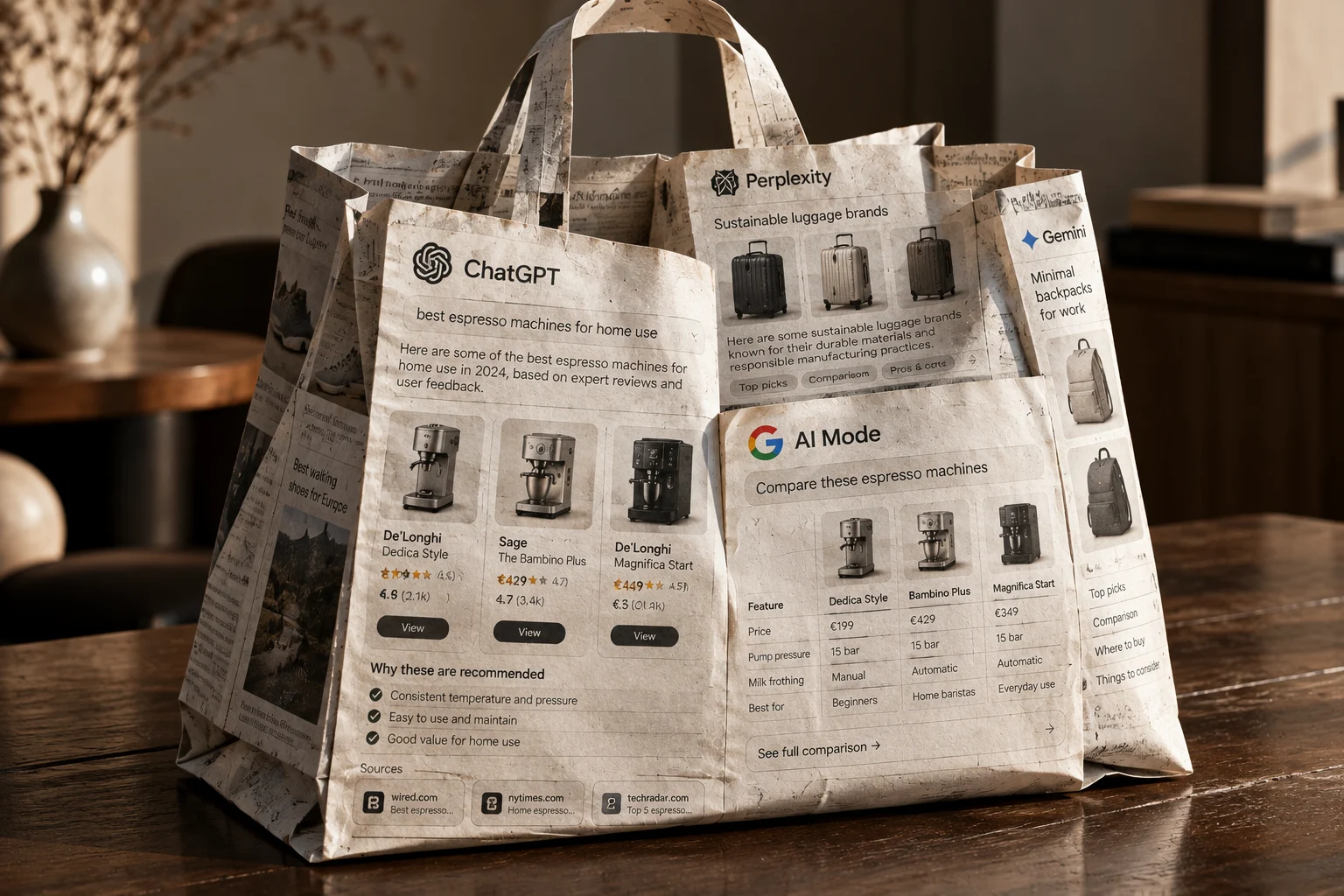
A customer can choose your product in ChatGPT, look up a retailer on Google and buy through its app. Your brand influenced the decision. Your website may never receive a visit. Your analytics may credit neither ChatGPT nor your business.
That is the commercial significance of AI search: it can help allocate demand before a transaction becomes visible to the seller. The question for businesses is no longer simply whether an assistant can answer a product question. It is whether it includes the right product, explains the trade-offs accurately and sends the customer to a place where they can buy it.
The evidence in October 2026 supports taking this seriously. It does not support treating AI as the dominant shopping channel, or assuming that more recommendations automatically mean more revenue. Businesses need to separate the decision, the referral and the order.
The shortlist is becoming a commercial interface
Conventional product discovery gives shoppers a collection of pages to investigate. Conversational discovery can turn a requirement into a shortlist: a lightweight laptop for frequent travel, a dishwasher for a narrow kitchen, a supplier able to deliver a particular component within the EU.
The important change is the work being delegated. A shopper can ask the assistant to decide which attributes matter, exclude unsuitable options and compare the remainder. A business therefore competes on how well its offer fits a specific situation, as well as whether its page can attract a click.
Consider a hypothetical buyer asking for a replacement office chair under £400, suitable for a small desk and available for delivery next week. A generic claim about ergonomic design provides little basis for comparison. Dimensions, adjustments, delivery restrictions, stock, warranty and returns make the offer assessable. These details help the customer decide even if the eventual sale takes place elsewhere.
This is an editorial interpretation of the emerging journey, not a claim to know any platform’s ranking weights. The opportunity lies in making the commercial facts available and credible. The platform still decides what to show.
What changed in 2026
OpenAI’s 24 March announcement moved its shopping emphasis towards richer product comparison and discovery, with ACP, the Agentic Commerce Protocol, extended to product data. It described side-by-side comparisons, merchant feeds and Shopify Catalog integration, while giving merchants more freedom over checkout. That was a change in product direction, rather than proof that shoppers had adopted autonomous buying at scale. OpenAI’s product announcement
The current merchant page reinforces that emphasis: it describes discovery followed by purchase on a merchant’s website or app, and says it is moving away from a standalone Instant Checkout experience. Its merchant programme still describes shopping as live in the US, with broader regional expansion planned. That should not be read as a statement that every conversational product-research feature is unavailable elsewhere. OpenAI’s merchant guidance, checked 28 October
There is a qualification. OpenAI’s consumer shopping help still says that some eligible products and merchants may offer Instant Checkout. The same page now documents virtual clothing try-on and saving products in Library. These are useful discovery and evaluation features; an illustrative try-on does not establish fit. The official pages describe different scopes, so neither “all shopping happens inside ChatGPT” nor “in-chat checkout has disappeared entirely” is a reliable summary. ChatGPT shopping help
Google is pursuing a broader commerce infrastructure. It announced the Universal Commerce Protocol on 11 January, then described Universal Cart and additional UCP features in May. The latter announcement includes both checkout with Google Pay and transfer to a merchant’s site. UCP connects commerce systems; it is not an SEO tag that makes an ordinary product page eligible for every buying feature. Google’s January announcement, May commerce update
Google’s current developer hub includes waitlist routes and surface-specific capabilities. A UK or European retailer should check its actual integration and market eligibility before budgeting for an on-platform checkout experience. A protocol being published, a retailer integration being announced and a feature being available to a particular customer are three different milestones. Google’s UCP developer hub
Large growth can coexist with a small channel
Similarweb’s September report summary puts generative AI referrals at 0.4% of retail ecommerce visits, despite 203% year-on-year growth. Both figures can be true: a small channel can grow quickly. The public summary does not provide enough cohort detail to treat that share as a forecast for an individual shop. Similarweb’s report overview
Its accompanying release also says that 89% of the time, consumers using AI in shopping research also use search. That is evidence of overlapping journeys in Similarweb’s analysis, not a percentage of all consumers or all purchases. The sensible business interpretation is that channels are combining. A marketing plan built around wholesale replacement of search would go beyond this evidence. Similarweb’s release
Adobe offers a different view, measured at retail destinations. Its July data reports AI-referred visitors to US retail sites converting 60% more often than non-AI traffic. That is a relative conversion-rate difference, not a 60% conversion rate. It describes visitors who arrived, not everyone who consulted an assistant. Adobe’s July findings
Higher conversion among arrivals is commercially interesting. It does not establish that AI caused those purchases. People who click through after a long comparison may already be unusually motivated, and the mix of categories, retailers and customers can differ from other channels. Adobe’s earlier research describes a transaction dataset covering over a trillion visits to US retail sites, plus a separate survey of more than 5,000 respondents. Those are substantial inputs, but neither is a randomised test of AI’s incremental contribution. Adobe’s methodology context
OpenAI now publishes another measure: its holiday advertising page reports more than 1.7 billion retail and ecommerce prompts a week from September internal data, and says approximately 43% of shopping-related conversations involved comparison and evaluation in a later four-week window. Prompts, conversations, visitors and orders are different units. These platform figures indicate activity; they cannot be added to referral statistics or used to calculate a market conversion rate. They also come from a page selling advertising. OpenAI’s holiday figures and date windows
01 Evidence snapshot
Fast growth. Small share.
AI is gaining ground in shopping journeys, but growth, traffic share and conversion are different measures.
+203%
Growth in generative AI referrals
Year on year, in Similarweb’s retail ecommerce analysis.
0.4%
Share of retail ecommerce visits
Generative AI referrals, in the same Similarweb report.
| Finding | What was measured | Source |
|---|---|---|
| 89% | Shopping research overlaps with searchAmong consumers using AI for shopping research, search was also used in Similarweb’s analysis. | Similarweb |
| +60% | Higher conversion rate among AI-referred visitorsRelative to non-AI traffic in Adobe’s study of US retail visitors; not a 60% conversion rate. | Adobe |
Source: Similarweb, State of Ecommerce 2026 and accompanying release; Adobe’s July findings. These figures describe different populations, measurements and denominators. They should not be compared as equivalent conversion or market-share statistics.
Recommending the product does not determine who gets the sale
A manufacturer, a reseller and a marketplace can all benefit differently from the same answer.
If an assistant recommends a particular vacuum cleaner but links to a large retailer, the manufacturer may gain demand while its direct store loses the opportunity to capture the order. The retailer gains a customer; the brand may receive only wholesale revenue. A brand-mention tracker would miss that distinction.
A small October investigation by WISLR illustrates the issue. Across four tracked product brands, it reported that 56% of retailer buttons pointed to big-box stores and about 5% to the brand’s own store during 10–13 October. It also reported a temporary loss of referral-identifying information in its link tests. This is a short, commercially interested observer’s study, with small per-brand counts. It is a reason to inspect destinations and tracking, not a market-wide estimate or proof of a selection algorithm. WISLR’s observations and limitations
For manufacturers, AI visibility research should therefore record the recommended product, the cited source and the purchase destination separately. Retailer listings deserve attention alongside the brand website: incorrect stock, incomplete variants or inconsistent specifications can affect the customer regardless of which organisation owns the page.
A measurement system needs four separate records
Recommendation evidence comes from retained answers to a defined set of buying questions. Record whether the product is a suitable recommendation, how it is described, the cited pages and where the buying links lead. This measures the tested answers, not total demand.
Referral evidence comes from analytics and server-side observations of visits. Preserve campaign parameters through redirects, check recognised AI sources and test a small number of actual outbound links. Tracking changes can alter the label without changing customer behaviour. Conversely, not every rise in direct traffic is hidden AI traffic.
Transaction evidence comes from completed, deduplicated orders. Connect identifiable visits to purchases where the measurement setup permits it, and review revenue, margin, cancellations and returns. A checkout button, cart addition or protocol integration is not a completed sale.
Incremental value asks a harder question: what happened because of the channel that would not otherwise have happened? Attribution reports assign credit under a rule. They do not supply that counterfactual. Where scale justifies it, controlled interventions or carefully designed comparisons can help; for a small retailer, the honest starting point may be descriptive reporting with explicit uncertainty.
Keep the records side by side. A high conversion rate cannot rescue a channel with negligible volume and poor margin. A low referral count cannot rule out influence earlier in the decision. The task is to explain both without quietly turning either into a revenue estimate.
02 Measurement framework
Four records. Four different questions.
A recommendation is not a visit. A visit is not an order. An order alone cannot prove incremental value.
| Evidence | What it can establish | What it cannot establish on its own |
|---|---|---|
| 01Recommendation | Whether a product was recommended for a defined buying need in a recorded sample of answers. | That the customer visited a site or made a purchase. |
| 02Referral | Whether a measurable visit arrived from an identifiable AI source. | The full influence of AI earlier in the customer journey. |
| 03Transaction | Whether a completed, deduplicated order was recorded and linked to a visit where possible. | That AI exposure caused the order. |
| 04Incremental value | With an appropriate comparison or experiment, whether a channel generated additional outcomes. | A causal conclusion from attribution reports alone. |
Measure recommendation, referral and purchase separately before making a claim about commercial impact.
Search Orchard editorial framework, based on the article’s measurement discussion. “Incremental value” requires a suitable causal design; it is not a directly observed metric in ordinary referral or order reports.
What businesses should do now
The most defensible investment is in commercial information that remains useful across buying routes. Maintain accurate product identifiers, variants, specifications, prices, availability, delivery terms and returns. Keep feeds and public pages consistent. Explain real constraints and use cases instead of relying on interchangeable descriptions.
Treat integration as a separate decision. Establish whether a supported catalogue route already exists, whether the relevant market is eligible and whether the expected volume warrants further engineering. OpenAI says a direct feed is optional where its systems already crawl a site; a feed can improve control over product information, but it does not guarantee selection. Merchant feed guidance
Retain conventional SEO. Customers still use search to verify a claim, find a merchant and return to a product. Google’s own guidance says established SEO practices remain relevant to its AI features. Eligibility and useful content still matter; there is no special schema that guarantees an AI appearance. Google’s AI feature guidance
For a business deciding where to start, the first review should connect product-data quality, technical access and measurement. That is where an SEO audit can establish practical constraints before a broader AI search visibility programme.
The sale can begin before the visit
AI search is becoming a sales channel because it can shape consideration and route customers towards a purchase. Owning the payment screen is only one possible expression of that role.
The immediate opportunity is to make your offer easy to assess and to understand which organisation receives the resulting demand. Measure recommendation, referral and purchase separately. Invest where the evidence shows relevant customers and commercial value, while keeping experimental checkout promises in proportion.
For the next layer of measurement, read why ChatGPT may not recommend a business and what Google’s new AI reports actually measure.