

BlogAI Visibility Research
Why Isn’t ChatGPT Recommending Your Business?
Separate brand mentions, recommendations and citations. Learn what recent research reveals and how to build a reliable ChatGPT visibility baseline.
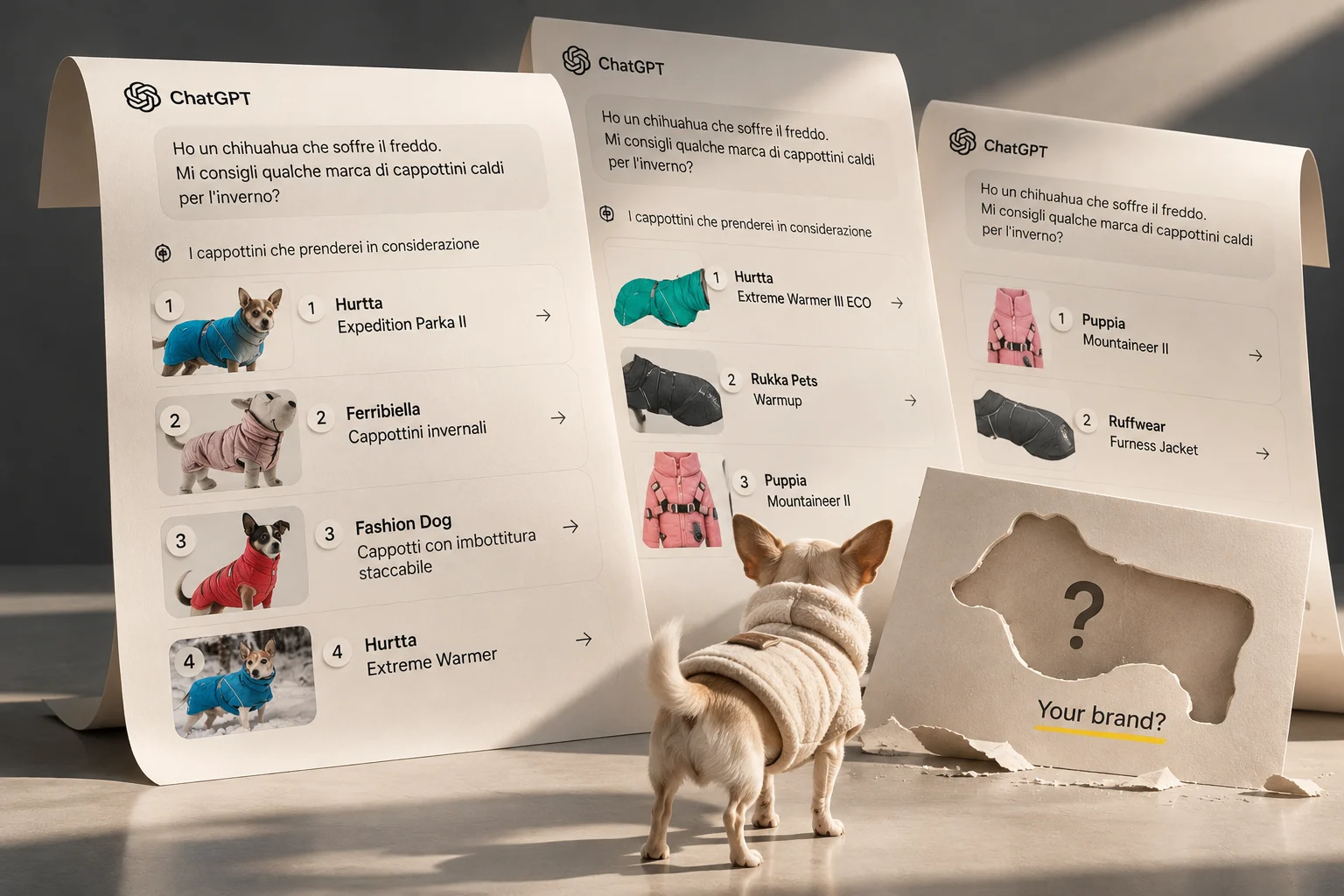
You ask ChatGPT for a shortlist of suppliers. Three competitors appear. Your business does not. A second attempt produces a different list, and a colleague gets another answer again.
The commercial concern is reasonable. The diagnosis is still missing.
An absent recommendation can reflect the question, the market, the available evidence or the particular answer generated. It can also expose a persistent competitive weakness. A single screenshot cannot distinguish those possibilities. Before changing your website, establish what is actually absent and whether that absence repeats across buying situations that matter.
The useful objective is a reliable picture of your competitive consideration set: the businesses an assistant includes for a defined customer need. That requires a clearer measurement system than a supposed “ChatGPT ranking”.
A mention, a recommendation and a citation are different observations
A mention means the answer names a business. It could name that business as an option, a competitor, a historical example or something to avoid.
A recommendation is a positive selection for the user’s stated need. “Consider Company A because it supports the required certification” is different from “Company A does not serve that market”. A recommendation may be conditional: suitable for a large manufacturer but unsuitable for a small order.
A citation links to a source used or presented in the answer. That source could be the supplier’s website, a trade publication, a directory or a comparison page. A supplier can be recommended using somebody else’s evidence. Its own page can be cited while the answer recommends somebody else.
Record all three, plus factual accuracy. Otherwise a campaign can appear successful because citations rose, even while commercially relevant recommendations remained unchanged.
The distinction is more than theoretical. In a small Ahrefs experiment tracking self-promotional content from February 2026, a conference-promoting page was sometimes cited without the promoted conference being named. The report found that the conference was skipped in 43% of those citation cases. This is a specific experiment involving a conference and a known product, not a universal failure rate for listicles or a controlled explanation of every assistant’s behaviour. Ahrefs’ experiment and qualifications
An unstable list can contain a stable competitive pattern
SparkToro and Gumshoe’s January research collected 2,961 responses to 12 prompts across ChatGPT, Claude and Google’s AI search experiences, using 600 volunteers. Exact lists rarely repeated, yet some brands appeared frequently. The collection took place in November and December 2025, with participants’ normal settings rather than uniform country, history and device conditions. The authors explicitly left questions about sample size and API equivalence open. SparkToro’s original methodology
It would be a mistake to turn “the full list changed” into “nothing can be measured”. A list containing five businesses can change because the fifth business rotates, while the same two competitors remain present. Exact-answer repeatability and brand-level persistence measure different properties.
A more recent Detailed study followed over 70,000 responses across ChatGPT and Google AI Overviews over 28 days, using commercially oriented prompts. Its published analysis separates a core of brands appearing on at least 80% of days from the remaining tail. Day-to-day turnover was much lower in that core. The study also tested leaders identified in the first fortnight against the second, reducing one form of hindsight bias. It still acknowledges that its prompts are imperfect proxies for real conversations. Detailed’s September study
The published daily turnover figures show the difference:
| Platform and entity | Core | Tail |
|---|---|---|
| ChatGPT: brands | 13% | 78% |
| Google AI Overviews: brands | 11% | 65% |
| ChatGPT: cited domains | 14% | 74% |
| Google AI Overviews: cited domains | 12% | 61% |
These are the study’s aggregate day-to-day change measures. They are not error rates or the chance that a particular business will disappear from the next answer. The figures are reproduced from Detailed’s published analysis, not independently recalculated from its underlying responses.
This suggests a practical question for a business: are competitors repeatedly present while your business repeatedly falls outside the consideration set? That is a stronger reason to investigate than a change in list order. It still does not tell you why the platform made its choices.
01 Research finding · Detailed, September 2026
Some brands stay. Others change.
Day-to-day turnover of brands shown in AI answers. The frequently appearing core changes far less than the remaining tail.
- Core · Appeared on ≥80% of days
- Tail · Other brands
ChatGPTBrands · daily turnover
Google AI OverviewsBrands · daily turnover
The practical takeaway: changing recommendation lists do not necessarily mean that every brand is equally unstable. Look for competitors that keep reappearing across relevant questions.
Source: Detailed, AI volatility study (September 2026). Published aggregate day-to-day turnover measures from a 28-day analysis of more than 70,000 responses. These are not error rates or the probability that an individual business disappears from the next answer. Values are cited from the article’s source, not independently recalculated.
Market and intent belong in the measurement
“Recommend a packaging supplier” is not a sufficiently defined competitive test. A UK food producer seeking certified packaging in small quantities has different requirements from a US distributor buying a container load. Language, delivery geography, order size, certification and purchasing stage can all change what constitutes a good answer.
Semrush’s October UK/US benchmark reinforces the need to segment. Across January–July, its fixed monthly prompt sets covered 2.5 million UK and 25 million US prompts for ChatGPT, Gemini and AI Mode, with a separate variable AI Overviews dataset. Pairwise overlap among the top 100 mentioned brands was lower in the UK than in the US. These are market-level benchmark findings, not expected visibility scores for a B2B supplier. Semrush’s October study release
In the reported benchmarks, any two platforms shared between 63 and 70 of their top 100 mentioned brands in the UK, compared with 70 to 78 in the US. These ranges describe observed benchmark overlap, not confidence intervals. They concern list membership, not agreement on rank order or the share of all answers mentioning a business.
A visibility tool’s prompt universe matters as much as the resulting score. Semrush’s live methodology page describes its current, expanded index; the downloadable October study has its own scope. Do not combine counts from the changing live index with a historical report and assume they describe one fixed experiment. Its overlap measure counts shared list members, not rank agreement. Semrush’s methodology
For your own baseline, a translated prompt is a new measurement condition. Keep UK English, US English and Italian tests separate. If the account is physically in Italy, saying “in the UK” in the prompt specifies the intended market; it does not make the session a UK-located test. Record both facts.
Build a baseline around real supplier decisions
A small B2B panel should begin with customer language: sales enquiries, procurement requirements, support conversations and the reasons prospects disqualify suppliers. Remove confidential details before using them. A list of Google keywords can suggest topics, but it is not a distribution of real ChatGPT conversations.
The following pilot is a proposed Search Orchard protocol. It has not been run, and this article claims no original ChatGPT experiment results. The numerical comparisons here come from credited published studies. A small rushed test would add less value than a reproducible method with its limits visible.
Start with six questions for one service category and one intended market. For example:
- “Which UK suppliers should a small food manufacturer consider for recyclable stand-up pouches, with low minimum order quantities?”
- “We need food-grade stand-up pouches delivered to Manchester. Which suppliers publish clear minimum orders and lead times?”
- “Which UK packaging suppliers provide evidence of food-contact compliance for stand-up pouches?”
- “What suppliers should a growing UK food brand compare for printed recyclable pouches and repeat orders?”
- “Which suppliers suit a UK business testing a new food product before committing to a large packaging order?”
- “We are comparing UK suppliers of recyclable food pouches. Which businesses explain materials, minimum orders and delivery terms clearly?”
These are realistic examples, not a claim that the suppliers returned will actually meet the requirements. Packaging sustainability and compliance claims require independent verification. The deliberately related prompts test different purchasing constraints within one category, rather than mixing unrelated industries into an impressive-looking total.
Run each question five times in a fresh conversation, giving 30 planned observations per wave. Repeat the same panel on a second date before changing the site. This is a pragmatic pilot size for spotting patterns and coding problems, not a statistically validated minimum or a representative share of customer demand. Add a matched US or Italian panel only as a separate cohort.
Keep the product surface, visible model label, search setting and account context consistent. Log the timestamp, timezone, device, interface language, intended market, actual session location, Memory and custom-instruction status. Record what the interface exposes; do not invent hidden temperature settings or model-version identifiers. If using an API instead, name the endpoint and model ID and report it as an API study. Its results are not automatically equivalent to the consumer interface.
Save the full response and linked sources, not just a screenshot of the top few names. Log errors, refusals and answers without brands. Use the same inclusion rules in every wave.
02 Proposed method · Not yet conducted
One answer isn’t a baseline.
A simple starting protocol: keep the market and service category consistent, vary the buyer’s actual requirements, and repeat each question before comparing results.
- Step 016Buying questionsOne product or service category. One intended market.
- Step 025×Fresh conversationsRepeat each question five times under recorded conditions.
- Step 0330Planned observationsKeep every full answer and its linked sources.
Six everyday procurement needs to test
Repeat on a second date. Compare patterns across two waves before claiming any improvement or persistent absence.
Illustration of the method described in this article, not completed research or observed recommendation counts. Thirty is a pragmatic pilot size, not a statistically representative sample. Keep failed runs separate and record the conditions under which answers were generated.
Measure presence without hiding the denominator
The main rate should be understandable without the software that produced it:
Recommendation frequency = valid answers recommending the business ÷ all valid answers in the defined panel.
Count a brand once per answer, even if it appears several times. Include valid answers that recommend no supplier in the denominator. Keep transport errors and failed runs separate, and report the completion rate. A refusal or a clarifying response is still an observed product outcome; report how you classified it and show its count rather than silently discarding it.
Publish mention and citation frequencies separately. For citations, distinguish links to the business’s domain from independent sources discussing it. Normalise known business aliases carefully, keeping similarly named companies separate. Preserve the original text so disputed classifications can be checked.
Compare results by question before pooling. Fifteen appearances across 30 answers could mean a supplier dominates three needs and is absent from the other three. A single 50% headline hides that useful distinction. In a larger study, a prompt-by-brand matrix should show both the count and denominator in each cell, with failures marked separately from zero recommendations.
Treat repeated runs as correlated observations, not 30 independent customers. For a small pilot, show counts, dates and ranges between questions. If formal uncertainty estimates are needed, account for clustering by prompt and date. A narrow binomial confidence interval based on every run being independent can imply more precision than the design warrants.
Maintain a fixed core panel for comparison, and document any exploratory questions separately. Adding easier prompts to the denominator after a site update can manufacture a visibility improvement without changing competitive performance.
What can improve, and how strong is the evidence?
Technical access has a documented role. OpenAI identifies OAI-SearchBot as its search crawler and distinguishes it from GPTBot, which concerns potential model training. Blocking the former excludes a site from ChatGPT search answers, while navigational links may still appear. Allowing the crawler removes an access barrier; it does not guarantee a recommendation. Verify CDN and firewall behaviour as well as robots.txt. OpenAI crawler documentation
Clear commercial facts are a sound editorial investment. Explain who the business serves, where it delivers, what it supplies and which constraints apply. Put verifiable specifications and limitations on relevant service or product pages. That helps a prospective buyer evaluate the business and gives retrieval systems usable material. The recommendation uplift from any particular rewrite remains something to test, not a guaranteed outcome.
Independent evidence deserves investigation, without invented weighting rules. Look at the sources repeatedly cited for the buying situations in your panel. Are relevant trade bodies, directories, specialist publications or customer reviews accurately describing the business? Correct errors and pursue legitimate coverage where it serves customers. A correlation between third-party prominence and AI visibility does not establish that buying mentions will cause a recommendation.
Format shortcuts need scepticism. No public evidence establishes a universal wording pattern, schema combination or llms.txt file that makes ChatGPT recommend a supplier. Google explicitly says its own AI search features need no special AI file or schema; that statement concerns Google and should not be presented as an OpenAI specification. Treat platform-specific experiments as experiments. Google’s documented requirements
A citation-gaining self-promotional list can also recommend your competitors. That is why the Ahrefs experiment matters: the outcome needs to be the business being accurately considered for the right need, not merely a link to a page you published.
Diagnose the gap before choosing the work
If the business is missing across repeated, relevant questions, investigate access, factual coverage and the independent sources associated with its category. If it appears for some needs but not others, examine whether that difference reflects a genuine limitation of the offer. If it is recommended with wrong facts, accuracy is the priority.
If visibility improves but enquiries do not, the next question is commercial. Are the tested needs valuable? Do real prospects use those questions? Are referrals arriving at a useful page? AI shopping’s relationship with sales is broader than a brand-mention count, and Google’s AI reports measure a different platform and unit again. Referral traffic is a weaker test still: AI search isn’t a traffic channel explains why.
An AI search visibility review should make those boundaries explicit. It should leave you with a defined baseline, retained evidence and priorities that fit your business, rather than a promise to “rank first in ChatGPT”.
Your business may have a visibility problem. Establishing that problem carefully is the first useful piece of optimisation.