

BlogAI Search & Commerce
AI Search Isn’t a Traffic Channel
Three new studies say AI search sends little traffic and GEO isn’t worth it. The data is right; the test is wrong. Here is what to measure instead.
In late October, three studies gave sceptics of AI search optimisation the numbers they had been waiting for. ChatGPT sends a tiny fraction of the visits Google sends. Google still produces almost all the conversions. AI visibility shows no reliable link with later branded or direct visits.
The data is sound. The conclusion many people drew from it, that AI search is not worth any attention, is not.
The studies answer one question well: how much traffic do AI assistants send to a website? That is a useful question. It is not the question a business deciding where to spend should be asking, because most of the AI search its buyers see does not happen in ChatGPT, and most of its effect never arrives as a referral.
What the three studies actually found
Marie Haynes analysed 12 months of GA4 data from 100 websites, over 145 million sessions. ChatGPT sessions equalled 0.62% of Google organic sessions; all language models together, 0.73%. ChatGPT visitors converted at 13.8% against 3.02% for Google organic, but the volume difference swamps the rate: Google drove 96.5% of the conversions across the channels she analysed. Her conclusion is that chasing ChatGPT citations optimises for the wrong target. Marie Haynes, “GEO is a distraction”
SEO Works benchmarked 95 GA4 properties from September 2025 to August 2026, with a 63-site subset for conversions. Organic search delivered about 39 times more sessions than AI assistants, and 3.2 AI conversions for every 100 organic ones. AI referrals converted 1.18 times as well as organic overall, but not everywhere: for the ten B2B product sites in the sample, they converted at 0.62 times the organic rate. SEO Works AI referral benchmark
Kevin Indig looked for hidden AI influence in direct and branded traffic across 12 sites, mostly B2B, and four brands. He found no reliable relationship between AI visibility and later branded search or direct visits. His own summary is careful: “An effect could still exist. I just couldn’t isolate it.” Kevin Indig, Growth Memo
Search Engine Roundtable collected the three under the headline that AI visibility is not worth investing in. Search Engine Roundtable, 22 October 2026 That headline goes further than any of the authors did.
What they could not measure
Each study measures what analytics can see: a session that arrives with a referrer from an AI assistant. Two important things fall outside that view.
Google’s own AI features. A click from an AI Overview or AI Mode reaches your site as an ordinary Google organic session. SEO Works says so explicitly and treats its AI figures as a floor for that reason. So when Haynes reports that Google drove 96.5% of conversions, part of that Google figure may already be AI search. The comparison is not AI against Google. It is one AI product against a search engine that now contains AI answers.
Decisions that end somewhere else. A buyer who reads an AI answer, notes three supplier names and later types one of them into Google, or emails a sales address directly, leaves no AI referral behind. Indig went looking for exactly this effect and could not isolate it in analytics. That is a finding about what analytics can detect, which he is careful to say. It is not proof that the effect is absent.
None of this rescues the inflated claims made for “GEO”. It narrows the question. A referral count tells you how much traffic one channel sends. It cannot tell you whether you were on the list a buyer acted on.
The biggest AI search surface is still Google
For most businesses, the AI answers buyers see most often appear at the top of a Google results page.
Semrush tracked a fixed panel of 400 commercial keywords in the US, monthly from September 2025 to August 2026. The share that triggered an AI Overview rose from 45.75% to 88%. Queries shaped like “best X for Y” reached 96.12%; “alternatives to” queries passed 82%. Semrush, AI Overviews and commercial modifiers Those are banking, ecommerce and software queries on US desktop, not a measure of every market. They are also exactly the queries in which a buyer is building a shortlist.
One small experiment suggests that leaving these features has a cost beyond the AI clicks themselves. Cyrus Shepard used Google’s controls to opt one site out of AI Overviews and AI Mode. Its AI impressions fell to zero, and its regular organic clicks fell as well. He estimated a click-through rate of about 0.9% on the AI impressions, and he calls it an admittedly small case study; AI Overviews still appeared on the same results pages, without his site. Search Engine Roundtable on the opt-out test One site cannot establish a rule. It does show why “Google SEO” and “AI search” are hard to separate into two budgets.
SEO Works found the same pattern from the other direction. Across its sites, growth in AI referrals and growth in organic traffic moved together, with a correlation of +0.534 after controlling for overall site growth. The authors read this as a shared cause, such as strong SEO and clear business information, rather than one channel feeding the other.
What AI search does instead
AI search compresses the research stage. A buyer who once opened ten tabs to compare suppliers can now ask for a shortlist with reasons: three companies that make the part, deliver to the market and hold the certification. The work of narrowing the field is done before anyone visits a website.
The screenshot below shows what that looks like. Asked for the best CNC machining service for prototypes, Google’s AI Mode returned a table of three suppliers, each with what it is best for, its lead times and its main trade-off, sourced from a Reddit thread and two supplier sites. A buyer can stop there.
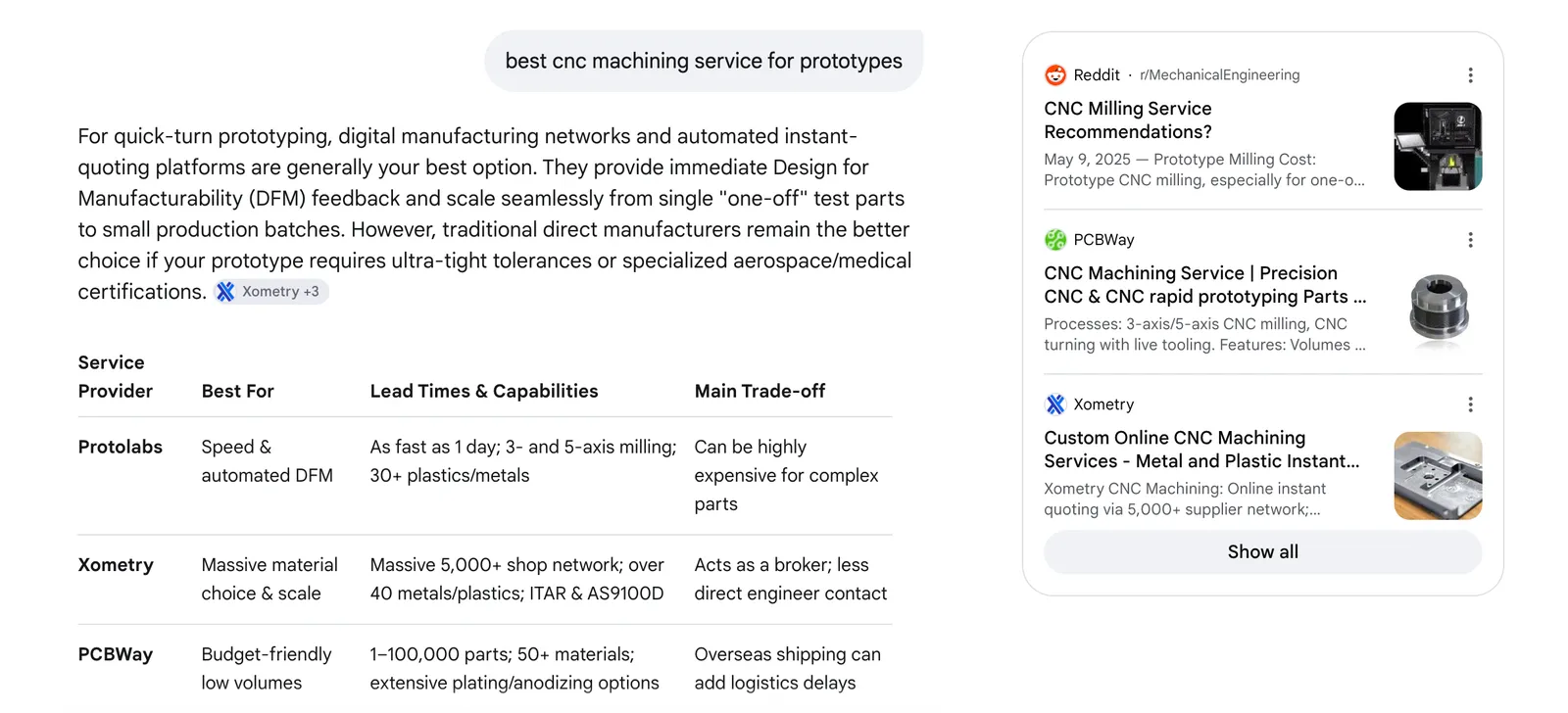
Google AI Mode, searched from Italy on 6 November 2026. Answers vary by location and over time.
That is why referral traffic is the wrong primary test. The commercial question is whether your business appears on that shortlist, described accurately, for the needs you can actually serve. A business that is consistently included can win the enquiry with almost no AI referral traffic. A business that is excluded loses it without any sign in analytics.
This is an interpretation, not a measured effect. Nobody has published clean evidence of how much revenue AI shortlists move, and the studies above are right to puncture claims that they move a lot. But it is the right hypothesis to test, and it can be tested.
What to measure instead
No single metric settles it. Use several signals that each cover a gap in the others.
| Question | Where to look | What it tells you |
|---|---|---|
| Are you on the shortlist for the questions buyers ask? | A fixed set of buyer questions, run on a schedule in the assistants and in Google | Whether you are considered at all, and how you are described |
| How often does Google show you in its AI features? | Search Console’s generative AI report | Exposure in AI Overviews and AI Mode, counted as impressions, not clicks |
| Is demand for your name growing? | Branded queries in Search Console | A slow and noisy indirect effect |
| Where did new customers first hear of you? | One open question on the enquiry form or the first call | The self-reported route that analytics cannot see |
| Do AI referrals turn into enquiries? | Referral sessions and key events in GA4 | Direct AI traffic, which is a floor, not the total |
The first row matters most and is the easiest to do badly. Fix the question set before you start, record mentions, recommendations and citations separately, and repeat runs, because answers vary. Why ChatGPT may not be recommending your business sets out how to build that baseline. Google’s AI reports explains what the Search Console data does and does not show.
The fourth row costs nothing and is underused. Indig recommends the same triangulation: where the brand appears in AI answers, how new customers say they found it, and what those customers then do commercially.
When it is not worth spending on
The sceptics are right in more cases than enthusiasts admit.
If your organic basics are not in place, fix those first. SEO Works modelled the effect per site: at current volumes, doubling AI referral traffic would add about 6.6 conversions a month, while a 5% increase in organic traffic would add about 10.3. A site Google cannot crawl, index or understand will struggle in AI answers too. Google’s AI features draw on the same index as its ordinary results.
If your buyers do not research this way, wait. In the SEO Works sample, AI referrals converted worse than organic for B2B product companies. Ten sites is too few to generalise from, but it is a reason to check your own enquiries before assuming your buyers use assistants the way consumers do.
If you cannot name the questions, you cannot measure the result. Any work sold as “AI optimisation” without a defined set of buyer questions and a baseline is unfalsifiable. That is where the industry’s credibility problem comes from.
The better question
“Is AI search worth investing in?” invites a yes or no answer, and the referral data pushes towards no. A more useful question is narrower: when buyers ask for suppliers like you, are you on the list, and is what it says about you correct?
If the answer is yes, there may be nothing extra to buy. If it is no, the fix usually looks like good SEO: clear, specific information about what you do, for whom and where, on pages search engines can reach, supported by sources others trust. An AI search visibility review should start by establishing which of those situations you are in, before anyone spends money trying to change it.