6 years
An Italian SEO consultant with B2B export experience
Six years helping manufacturers develop international markets through brand development and digital marketing. That commercial experience informs my SEO strategy.


I help international businesses reach Italian customers and grow sales through SEO. Based in Turin, I specialise in Italian market research, technical SEO, content localisation and international search strategies for B2B manufacturers.
With six years of experience in international B2B marketing, I build Italian SEO strategies around your priority products, target buyers and export objectives.
Breaking into the Italian market is one thing. Becoming a supplier that Italian buyers can find, trust and do business with is another.
Italy has been my home and place of work for many years. As an independent Italian SEO consultant based in Turin, Italy, I know the local business culture, the search landscape and how Italian buyers research products and evaluate suppliers.
My particular strength lies in international SEO and export marketing for B2B manufacturers. I understand the commercial decisions behind entering a new market, from product positioning and distribution channels to customer acquisition. That is where I start with your SEO strategy, whether the opportunity lies in Google.it, Bing or AI search tools.
The ambition is clear: to establish your business in the Italian market and make organic search a profitable channel for your international growth.

Effective SEO in Italy starts with understanding local search demand, market competition and purchasing behaviour. For international businesses, Italian SEO should form part of a wider export and digital marketing strategy, with investment directed towards the products, customers and sales opportunities that matter most.
| Key SEO factors | Common mistakes | Effective Italian SEO strategy |
|---|---|---|
| Italian keyword research | Translating the keywords that perform well in your home market without validating Italian search demand, terminology or purchasing intent. |
|
| Search intent & market competition | Reusing your existing keyword map, competitor analysis and landing page structure when expanding into Italy. |
|
| Italian language & content localisation | Publishing translated website copy, metadata and product descriptions without adapting the information to Italian customers. |
|
| Italian business culture & buyer trust | Expecting international brand recognition, translated brochures and existing customer testimonials to establish commercial credibility automatically in Italy. |
|
| Technical & international SEO | Adding an Italian-language version without reviewing indexability, international targeting, canonical tags or website architecture. |
|
| Italian link building & digital PR | Buying generic backlinks or relying entirely on the authority and brand recognition earned in your home market. |
|
| AI search & GEO | Measuring visibility exclusively through traditional keyword rankings while overlooking AI-generated product and supplier recommendations. |
|
| SEO & Italian digital marketing strategy | Treating SEO as an isolated traffic acquisition activity, disconnected from export objectives, marketing campaigns and sales operations. |
|
Research source: Search Orchard, Semrush Italy database, 25 November 2026. Analysis of 22 precision engineering and CNC machining searches, covering 220 desktop organic search positions in the top 10.
Your export priorities shape my SEO strategy: the products you want to sell, the Italian buyers you want to reach and the search opportunities that can generate business.
6 years
Six years helping manufacturers develop international markets through brand development and digital marketing. That commercial experience informs my SEO strategy.
Targeting Italian search demand around your priority products, target industries, profit margins and export objectives.
Understanding how Italian procurement teams, engineers and distributors search for products and evaluate suppliers.
Combining technical SEO, localised content and product page optimisation to reach Italian buyers and generate qualified enquiries.
Find the terms Italian engineers and buyers use for each of your product families, and see who already ranks for them.
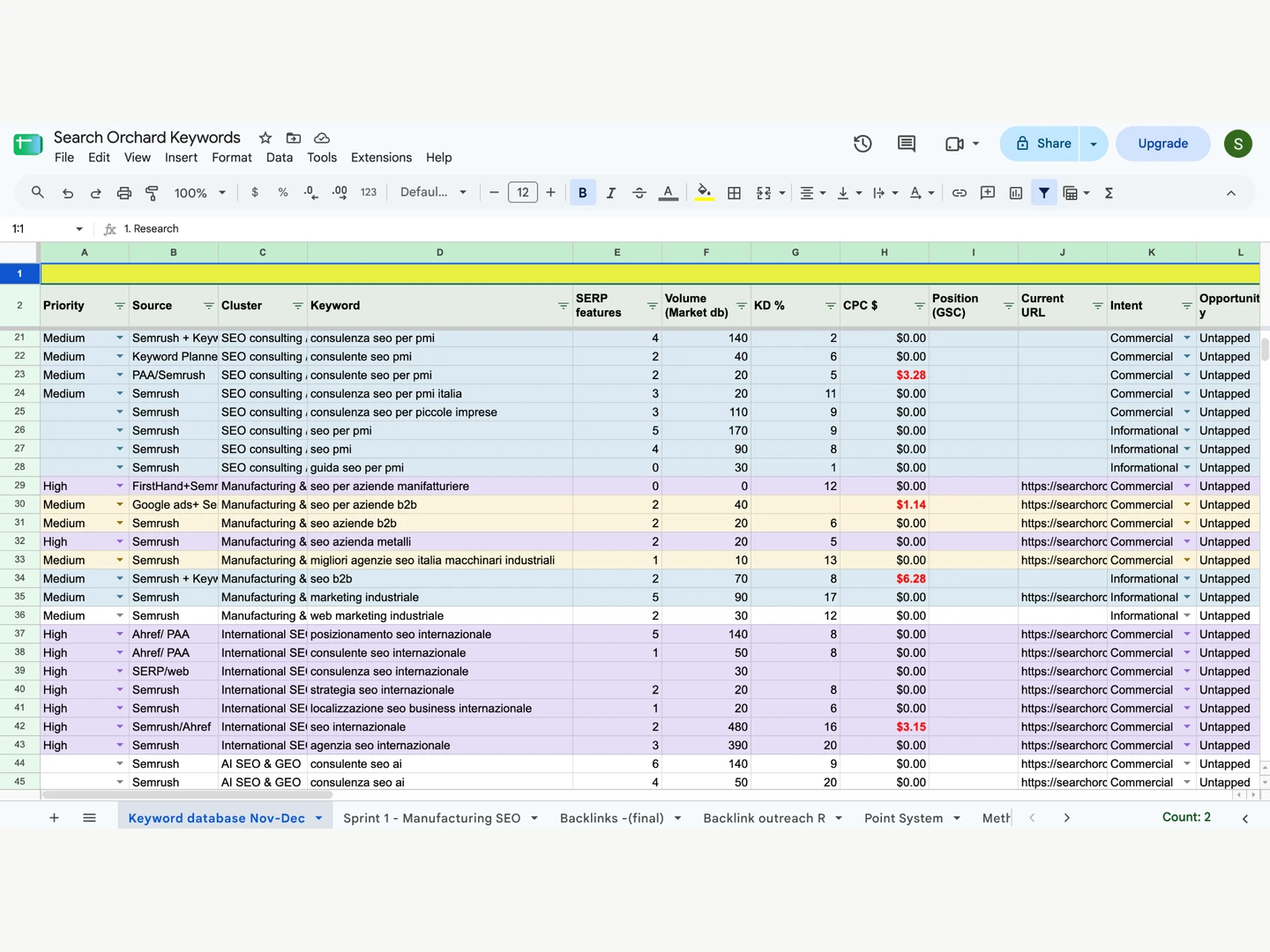
My actual working spreadsheet for Italian SEO keyword research.
Check your site against those searches, from product pages to RFQ forms and distributor pages, and decide what to fix and build first.
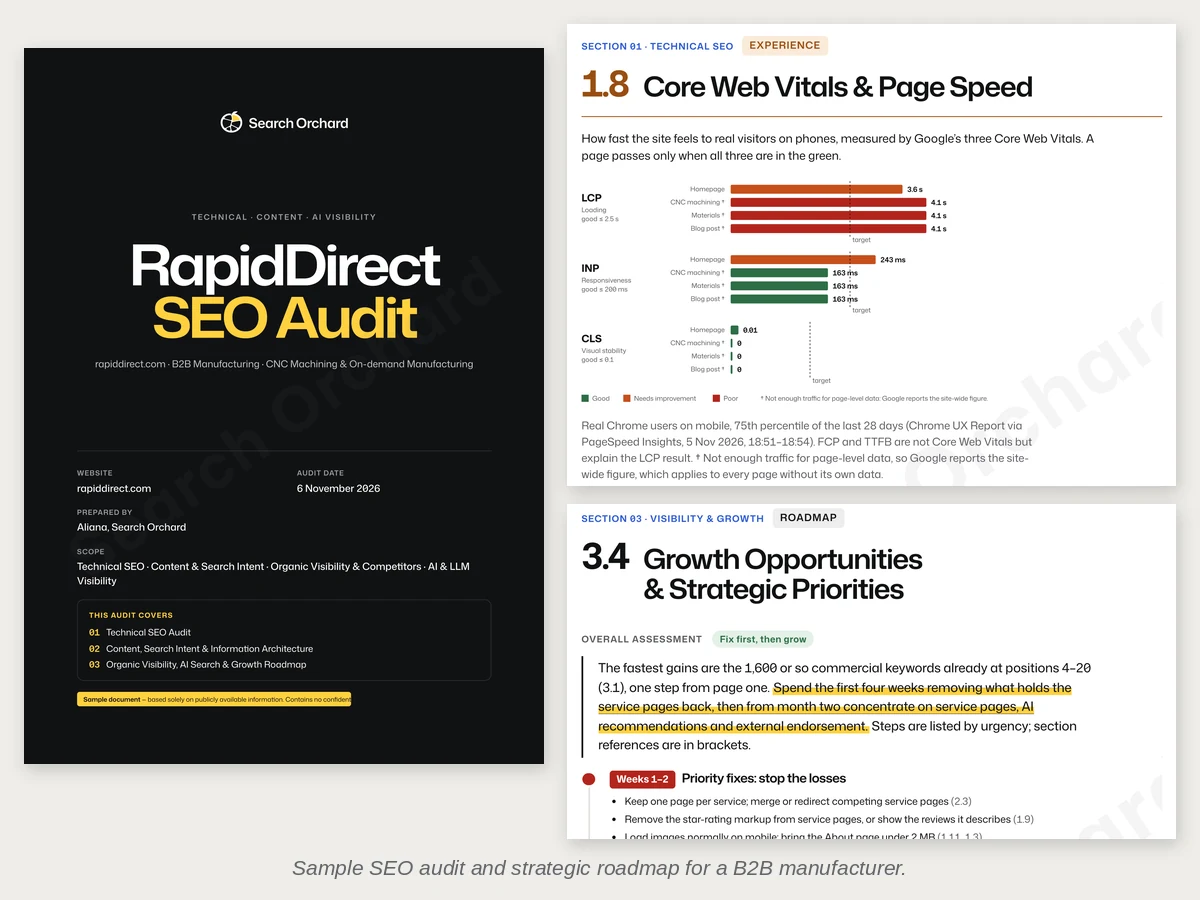
Make sure Google shows the right page to buyers in Italy, with a clean Italian site structure that loads fast.
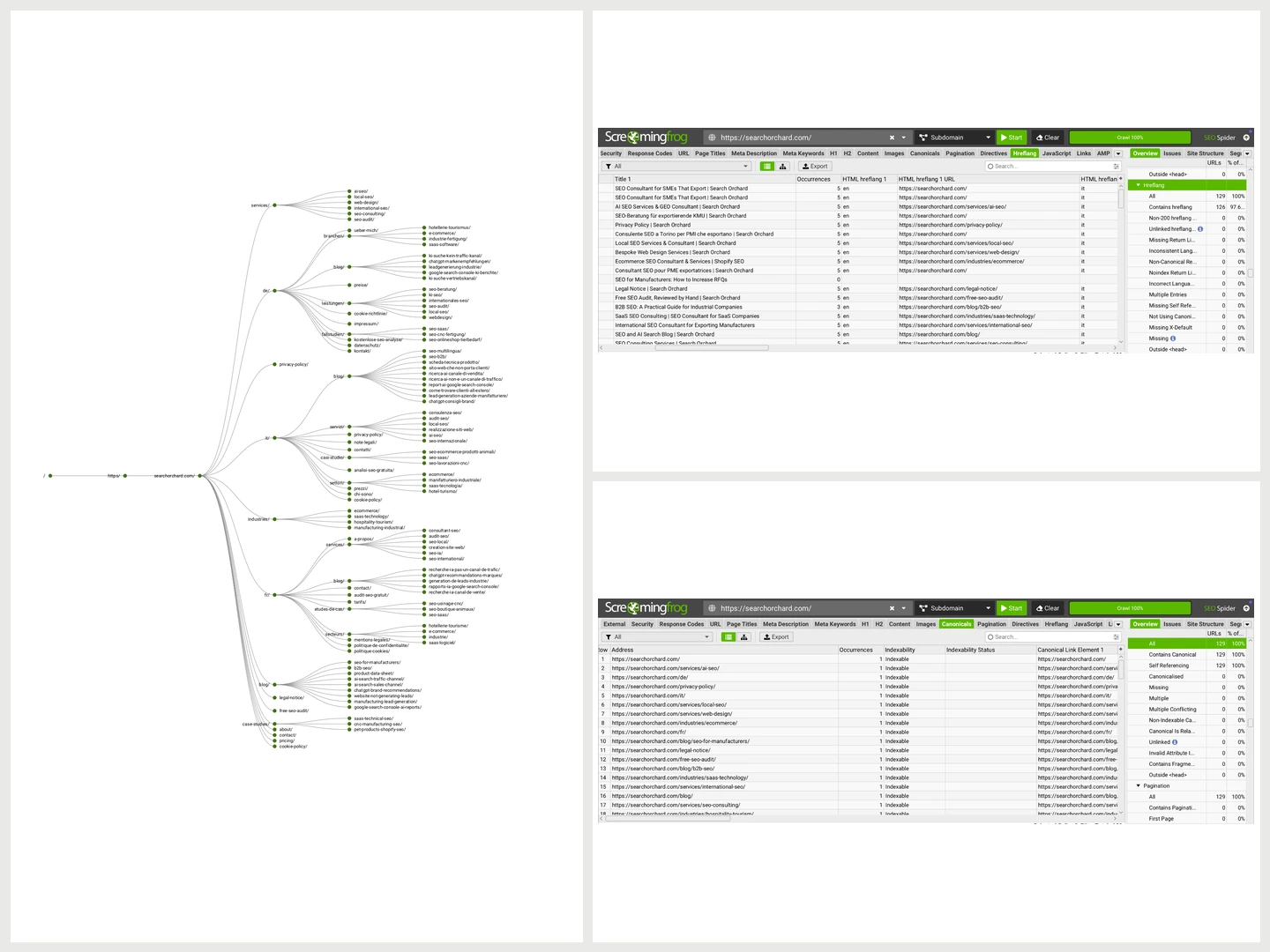
A glimpse into the international SEO architecture of my own website.
Product and application pages written in Italian for Italian buyers, with specifications checked by your engineers.
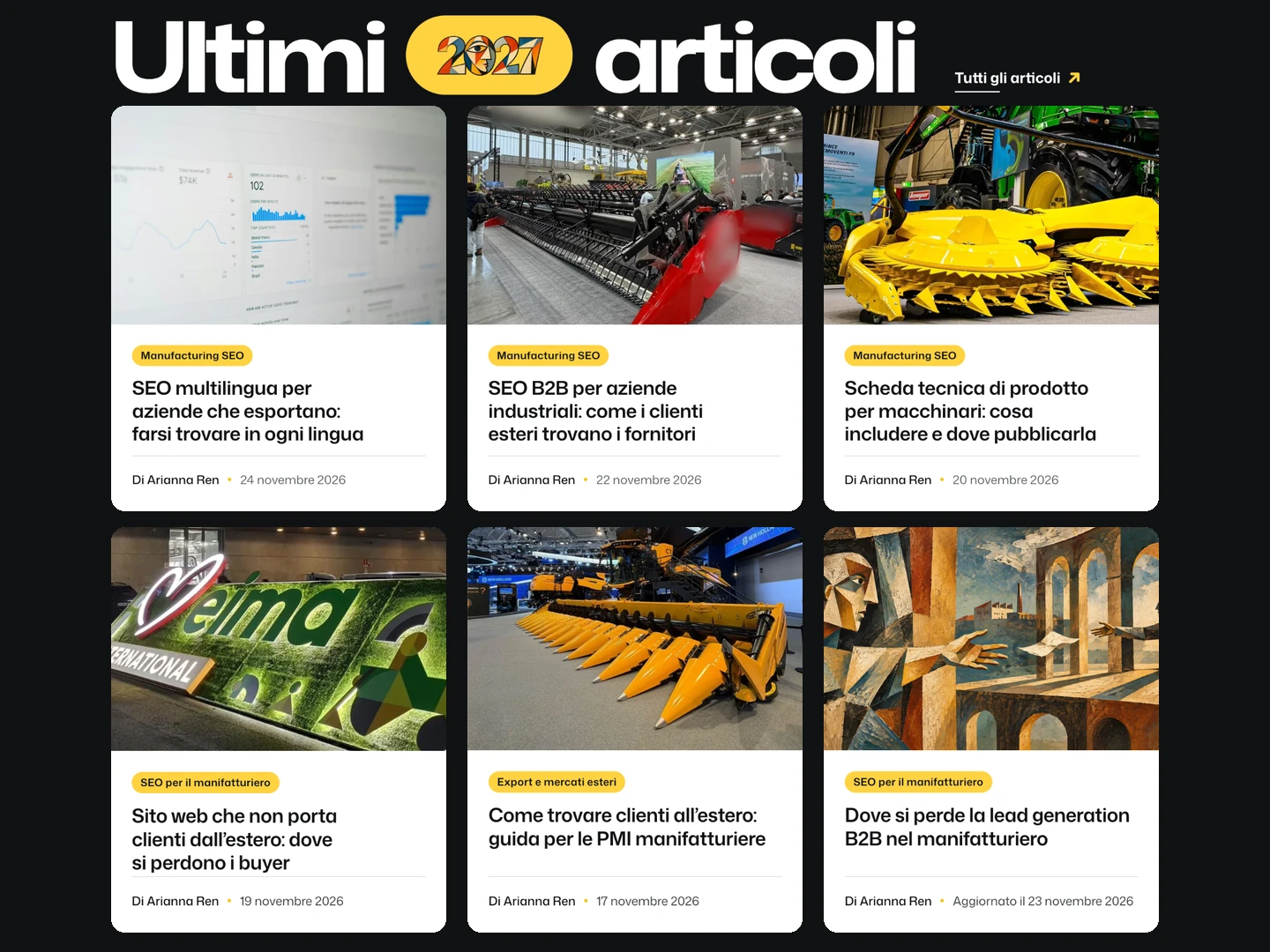
Native Italian blog content, a very small part of my wider localisation work.
Earn mentions in the Italian trade press, sector directories and associations that buyers and Google already trust.

Off-page SEO and industry networking at an Italian B2B manufacturing exhibition.
Search Console and analytics set up for Italy, with enquiries tracked by product and a monthly report on what to do next.
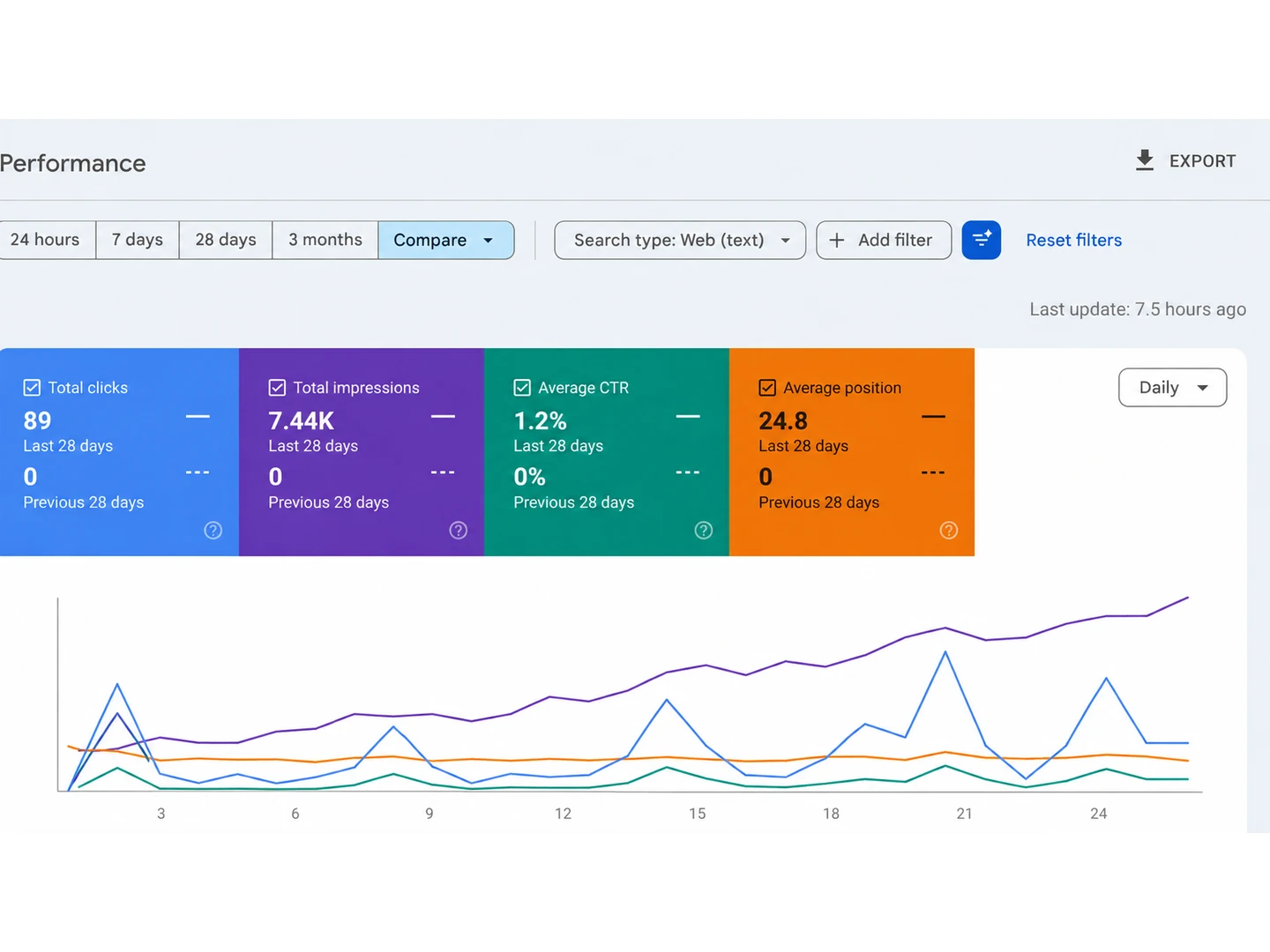
Organic search growth from scratch for a newly launched client website.
The right Italian SEO specialist turns search demand into qualified enquiries, new customers and revenue growth in Italy.
| What matters to your business | Translation agency | Search Orchard | SEO agency |
|---|---|---|---|
| Primary focus | Language-driven | Revenue-driven export growth | Traffic & visibility |
| Italian buyer intelligence | Language & culture | Buyer demand, sourcing behaviour & sales channels | Search behaviour |
| B2B manufacturing expertise | Technical translation | Industrial products, OEMs, distributors & RFQs | Sector-dependent |
| International marketing experience | Varies | 6 years in B2B international marketing | Agency-dependent |
| Italian market entry strategy | — | SEO aligned with your market entry strategy | Scope-dependent |
| Local presence in Italy | Location-dependent | Based in Turin · On-site support | Location-dependent |
Comparison of typical service models. Individual providers may differ.
Before investing in SEO in Italy, you need to know which products have the strongest demand, who your potential buyers are and how they search for suppliers. That's where I start.
01Opportunity
I assess Italian market demand, product margins, competition and sales channels to identify which products and commercial opportunities deserve your SEO investment.
02Strategy
Italian keyword research, competitor analysis and a technical SEO audit determine which searches to target, which pages to build and which issues to fix first.
03Visibility
Product specifications, applications and technical capabilities are the priority. Content localisation, technical SEO and relevant Italian industry backlinks help these pages compete in search results.
04Growth
Which products generate qualified enquiries, quotations and orders? Search data and sales feedback guide my decisions on where to invest next.
16
International markets successfully entered
10+
B2B manufacturing brands supported
50+
New international customers acquired
3M €+
Value of sales opportunities generated
2026 SEO and digital marketing results achieved as part of my previous team.
Read my manufacturing SEO case study: a technical SEO recovery that resulted in a 197% increase in enquiries.
495 €
One-off
Identify what's limiting your visibility in Italy and where to invest first.
Explore SEO Audit1,490 €
Per month
Ongoing SEO strategy and execution to reach Italian buyers, generate qualified enquiries and grow revenue.
Explore Monthly SEOCustom quote
Project-based
Tailored SEO strategies for complex websites, multilingual expansion and growth across Italy and additional international markets.
Discuss your projectWhen choosing an Italian SEO consultant or agency, look beyond keyword rankings and service packages. Consider (1) their understanding of the Italian market, (2) their technical and international SEO expertise, (3) their industry experience, (4) evidence of previous results, and (5) who will actually carry out the work.
At Search Orchard, you work directly with me throughout the project, from initial research and strategy to implementation, optimisation and reporting. No account managers. No handovers between departments. No separate delivery teams. The person who understands your business and develops your SEO strategy is also responsible for executing it.
Cost is another consideration. According to Whito's 2026 UK SEO pricing research, monthly retainers typically range from £1,000 to £3,000 for small agencies and £3,000 to £7,000 for mid-sized agencies, depending on scope. As an independent SEO consultant with lower operating overheads, I can offer competitive pricing and dedicate more of your budget to hands-on SEO work.
Combined with my experience in international B2B marketing and export development, this one-to-one consultancy model offers direct communication, commercial understanding and consistent accountability.
Google is by far the most widely used traditional search engine in Italy. According to Statcounter Global Stats, in October 2026, Google accounted for 88.06% of the Italian search engine market, followed by Bing at 5.83% and Yahoo at 4.61%.
However, national search engine market share does not necessarily reflect the behaviour of your specific target audience. Corporate buyers may use Bing through workplace devices, while engineers and procurement professionals also research products through specialist directories, industry publications and supplier websites.
AI-powered platforms such as ChatGPT, Gemini and Perplexity provide additional channels for product discovery and supplier evaluation. An effective search marketing strategy in Italy should prioritise these channels according to your industry, customer behaviour and commercial objectives.
Yes. Google does not require a website to be written in Italian to rank in Italy. English-language websites can compete for international brands, product model numbers, technical terminology and searches that Italian professionals conduct in English.
For example, an industrial automation supplier may already receive Italian traffic for terms such as industrial IoT, SCADA software or specific PLC model numbers. However, Italian-language searches for automazione industriale, sistemi di supervisione or quadri elettrici industriali may represent additional commercial opportunities.
Before investing in an Italian website, I assess your existing organic visibility in Italy, the language of relevant search queries, the competition and the commercial potential of each product category.
You do not necessarily need to localise your entire website. Starting with your highest-priority products and services can be a more cost-effective way to validate Italian search demand before expanding further.
No. A .it domain provides a country-specific geographic signal, but it is not a requirement for ranking on Google in Italy. International businesses generally have three options:
(1) Country-code domain (example.it). Suitable for businesses operating a dedicated Italian brand, subsidiary or independently managed website.
(2) Subdirectory (example.com/it/). Often the most practical option for international businesses managing multiple languages under a single domain, particularly when the existing website has an established backlink profile.
(3) Subdomain (it.example.com). Useful when the Italian website requires separate infrastructure, a different CMS or independent technical management.
The right choice depends on your existing domain, website architecture, operational resources and international expansion plans. Correct hreflang implementation, canonical tags, internal linking and indexability are essential considerations when managing multilingual websites. Google's guidelines for multilingual and multi-regional websites explain the technical considerations behind these structures.
You do not need an Italian office, registered company or Italian VAT number to rank in ordinary organic search results. Google Business Profile and local map visibility are subject to separate eligibility requirements.
No. Translation preserves the meaning of your original content, while SEO localisation adapts it to Italian search behaviour and purchasing requirements.
Even a linguistically accurate translation may fail to generate organic visibility if it targets the wrong terminology, follows an unsuitable page structure or overlooks commercially relevant searches.
Through a targeted SEO audit of your existing Italian website, I determine (1) which pages already perform well in Italy, (2) which pages require keyword and content optimisation, (3) which commercial search opportunities require new landing pages, and (4) which technical issues prevent Italian pages from being discovered or indexed.
This approach avoids unnecessary rewriting and directs your SEO investment towards the pages with the greatest commercial potential.
Improving AI search visibility requires businesses to understand how their brands, products and expertise are represented in AI-generated answers across Google AI Overviews, AI Mode, ChatGPT, Gemini and Perplexity.
My AI SEO services combine traditional SEO with Answer Engine Optimisation (AEO) and Generative Engine Optimisation (GEO). The process involves:
(1) Analysing commercially relevant Italian-language prompts, competitor mentions and cited sources.
(2) Publishing original, accurate and verifiable content that addresses specific customer questions and purchasing requirements.
(3) Improving technical accessibility, website structure and structured data where appropriate.
(4) Strengthening brand credibility through relevant Italian publications, industry associations and independent third-party references.
Rather than optimising exclusively for AI mentions, I monitor AI search visibility alongside traditional organic performance, referral traffic and qualified enquiries. The objective is to make your business discoverable and credible wherever potential customers conduct their research.
I recommend planning Italian SEO campaigns over six to twelve months, although initial improvements can occur considerably earlier. The timeframe depends on your website's existing authority, technical condition, competition and implementation resources.
I typically structure an SEO campaign around three stages:
(1) Months 1–3: Market research, technical improvements, keyword mapping, priority page optimisation and early search visibility.
(2) Months 3–6: Expansion of commercially relevant rankings, organic traffic, content coverage and enquiry generation.
(3) Months 6–12 and beyond: Continued authority building, conversion optimisation and further investment in proven commercial opportunities.
These are indicative planning stages rather than guaranteed results. An established website with existing Italian content may progress faster than a new website entering a competitive market.
For B2B manufacturers, the time between initial organic discovery, quotation and confirmed order must also be considered when evaluating SEO performance.
I measure the return on investment of Italian SEO by connecting organic search performance with qualified leads, sales opportunities and revenue.
The measurement framework covers four areas:
(1) Search visibility: Italian keyword positions, impressions, organic clicks and commercial landing page performance through Google Search Console.
(2) Conversion performance: Requests for quotation, contact form submissions and other relevant conversion events through Google Analytics 4 and appropriate tracking.
(3) Lead quality: The relevance of each enquiry to your target industries, priority products and ideal customer profile.
(4) Commercial results: Quotations, confirmed orders, revenue and gross profit, where CRM and sales data are available.
Where sufficient attribution data is available, SEO ROI can be calculated by subtracting the total SEO investment from the attributable gross profit and dividing the result by the investment.
Where long sales cycles make immediate revenue attribution difficult, qualified enquiries and sales pipeline value provide useful intermediate indicators. These insights help determine which products, pages and markets deserve further SEO investment.
Yes. Manufacturers do not need to sell directly to end customers to benefit from Italian SEO. Organic search can generate product demand while supporting the commercial activities of local distributors, importers and dealers.
An effective strategy can target two distinct audiences:
(1) End customers: Optimise product and application pages to reach potential buyers researching machinery, components or industrial solutions. Connect them with the appropriate Italian distributor through dealer locators, product-specific enquiry forms or dedicated local partner pages.
(2) Potential distributors: Develop content addressing importers and dealers looking for new manufacturers, complementary product ranges and commercial partnerships in Italy.
The conversion and reporting process should reflect your distribution agreements. Where enquiries are transferred to local partners, an agreed feedback process helps track lead quality, quotations and sales opportunities.
With my background in international B2B marketing, I approach SEO as part of your wider export and distribution strategy, rather than treating organic traffic as an isolated marketing objective.
Contact
You'll hear directly from me. No sales team, no scripted discovery calls and no automated follow-up emails.
I read your message and take a first look at your website and its search visibility before replying.
Within two working days, I'll share my initial thoughts and tell you whether I'm the right fit.
If it's a fit, we'll arrange a call to discuss your project. If not, I'll tell you and suggest a better direction where I can.
Would you rather talk first?
Book a call